The OLED (Organic Light Emitting Diode) is a brighter, higher contrast display that has faster response times, wider viewing angles, and consumes less power than conventional VFD, LED or Liquid Crystal Displays. OLED displays are self-illuminating due to their organic material and require no backlight for maximum visibility in all environments. This also allows OLEDs to be significantly thinner than standard LCDs or VFDs. Newhaven Display offers OLED displays as complete, easy-to-use, character and graphic modules. The character OLEDs are monochromatic displays, offered as standard or slim module sizes. The graphic OLED displays are available as monochromatic or full color modules.
Newhaven Display’s Character OLED modules come in standard sizes and can be used as compatible replacements for LCD or VFD modules. They use serial or parallel MPU interfaces; have LCD compatible instructions and 4 built-in font tables.
Bei den Slim Character OLEDs handelt es sich um schlanke displays, die sich ideal für neue Produktdesigns eignen, die ein Display mit einem Profil von 5 mm erfordern, das bei Temperaturen von -40°C bis +85°C mit Batteriestrom betrieben werden kann. Diese Slim-Character-OLEDs sind auch eine preisgünstigere Option und bieten dennoch lebendige Qualität mit einem Kontrastverhältnis von 10.000:1. Die Slim OLEDs bieten außerdem zusätzliche Farboptionen wie Gelb, Rot, Blau und Grün.
Newhaven Display’s Graphic OLED modules are easy to use, all-in-one designs. Most Graphic OLED displays require multiple high-voltage power supplies and external logic components. Newhaven Display’s custom designed module boards for each Graphic OLED allow the user to have just one interface supply. The Graphic OLED module board has all the required external logic components, making it fast and easy to start using the displays.
Newhaven Display’s graphic OLEDs stepped up to a whole new level once adding 18-bit full color graphic options. These full color OLEDs are passive matrix displays and are available in 128×96, 128×128 and 160×128 resolution sizes. Newhaven Display’s full color OLEDs include a module containing all necessary logic, have built-in sleep mode and 256-step brightness. Available upon request, these full color OLEDs can also include a resistive or capacitive touch panel.
Newhaven Display’s standard character OLEDs are compatible with some of our Character LCDs and VFD modules. Below is a chart indicating which LCD Character or VFD module can be replaced by these standard Character OLEDs.
| Displays | LCD Character Displays | VFD-Modul-Modelle |
|---|---|---|
| NHD-0216KZW | NHD-0216K1Z | M0216SD-162SDAR2-1 |
| NHD-0216SZW | NHD-0216SZ | M0216MD-162MDBR2-J |
| NHD-0220DZW | NHD-0220DZ | M0220SD-202SDAR1 |
| NHD-0420DZW | NHD-0420DZ | M0420SD-204SDAR1-3 |
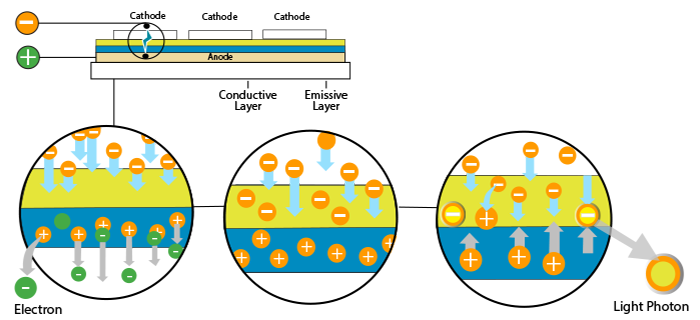
OLED Displays are made up of a layer of organic material placed between two conductors. These two conductors (an anode and a cathode) are then between a glass top plate (seal) and a glass bottom plate (substrate). When an electric current is applied to the two conductors, the organic material produces a bright, electro-luminescent light. When energy passes from the negatively charged layer (cathode) to the other (anode) layer, it stimulates the organic material between the two, which in turns emits lights that is visible through the outermost layer of glass.
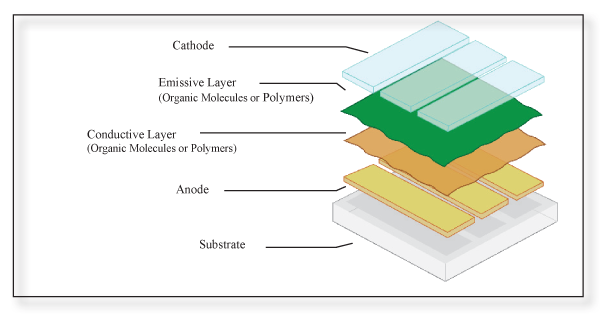
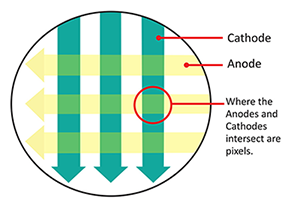
In order for OLED displays to produce color, an electric current is needed to stimulate the relevant pixels on the OLED display. The pixels are created by the arrangement of the cathodes and anodes; which are arranged perpendicular to each other. The electric current applied to the selected strips of anodes and cathodes determine which pixels get turned on and which pixels remain off. The brightness of each pixel is proportional to the amount of applied current.
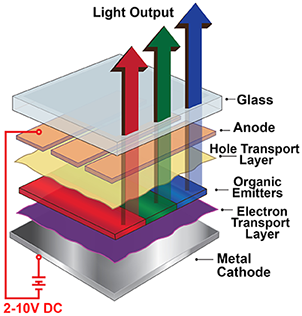
Color OLEDs consist of a metal cathode with a negative charge, an electron transport layer, organic material, a hole transport layer, and an anode with a positive charge. The cathode and anode are arranged perpendicular to each other, creating a pixel where they intersect. Each pixel of a color OLED is divided into red, green, and blue sub-pixels. When the controller sends an electric current to a particular pixel, the current passes through the organic material causing the material to emit light. By adjusting the intensity of the electric current in each red, green, and blue sub-pixel, specific colors and gradients can be created.
1. Elektrischer Strom fließt von der Kathode zur Anode durch die organischen Schichten, gibt Elektronen an die emittierende Schicht ab und entnimmt Elektronen aus der leitenden Schicht.
2. Durch das Entfernen von Elektronen aus der leitenden Schicht bleiben Löcher zurück, die in der emittierenden Schicht mit Elektronen gefüllt werden müssen.
3. Die Löcher springen zur emittierenden Schicht und verbinden sich wieder mit den Elektronen. Wenn die Elektronen in die Löcher fallen, geben sie ihre zusätzliche Energie als Licht ab.