COG (Chip-On-Glass) displays are monochromatic passive or active matrix LCD displays that can display information as text or in a dot matrix pattern. Unlike typical LCD displays, COG displays don’t have a built-in PCB board and instead have the IC directly mounted on the glass of the display. This type of technology is perfect for less demanding applications since they require less power than VFDs, are smaller in size and are typically less expensive than other display technologies.
Newhaven Display offers passive matrix character and graphic COG display types. The character COG displays come in standard sizes and feature pins on them for communicating to the IC. They also have pre-programmed font tables to display simple text and are available as either STN or FSTN type displays.
Newhaven Display’s Graphic COG LCDs are available in standard sizes and feature a flex cable for communicating to the IC. Like graphic LCDs, they use a dot matrix pattern to display both text and simple bitmap images. These displays also come as either STN or FSTN type displays. Newhaven Display offers custom designs for both the character and graphic COG LCDs.
Um zu verstehen, wie COG-LCDs funktionieren, ist es wichtig zu wissen, wie sie hergestellt werden. Zunächst einmal bestehen COG-LCDs aus zwei Teilen polarisiertem Glas. Auf der nicht polarisierten Seite des Glases wird ein spezielles Polymer hinzugefügt, um Rillen zu erzeugen, die in dieselbe Richtung wie die Polarisationsfolie verlaufen. Anschließend wird ein Flüssigkristall auf die gerillte Seite eines der polarisierten Gläser aufgebracht. Diese Rillen richten den Flüssigkristall am Glas aus. Das zweite Glas wird mit der gerillten Seite nach innen aufgesetzt und senkrecht zu den ersten Gläsern ausgerichtet, so dass eine Reihen- und Spaltenanordnung entsteht. Der IC wird dann direkt auf das Glassubstrat geklebt, und zwar durch Verbindungen zwischen Al-Pads auf dem IC und entsprechenden Elektroden auf der Platte. Zwischen den Pads und den Elektroden befinden sich leitende Partikel.
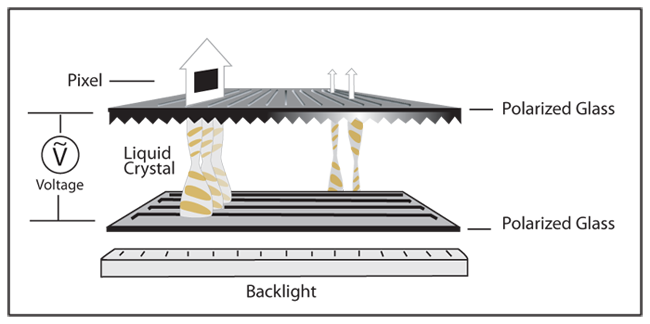
Where the grooves of the two pieces of polarized glass intersect is a pixel. By blocking the light from passing through the top piece of glass, it creates an area that is darker than its surrounding. This gives the appearance of pixels being turned on or off. In order to block the light from passing though, the orientation of the liquid crystal has to be changed. To do this, an electric charge is needed. Without an electric charge, the liquid crystal is twisted which changes the angle of the light to match the angle of the top polarized glass. This allows light to pass through. When an electric charge is applied, the liquid crystal untwists leaving the angle of the light unchanged. This causes the light to be blocked by the top perpendicular piece of polarized glass (see above animated image for example). Determining which pixels turn on and off is done by the controllers on the display. These controllers are programmed to translate user data into predefined fonts or to turn on the appropriately addressed pixels.
COG-LCDs gibt es in verschiedenen Anzeigemodi, die beiden am häufigsten verwendeten sind STN und FSTN. displays (super-twisted neumatic) bieten mehr Kontrast als displays (twisted neumatic), indem die Kristallmoleküle um 180 bis 270 Grad verdreht werden. Bei displays (filtered super-twisted neumatic) wird eine Filmkompensationsschicht zwischen dem STN-Display und dem hinteren Polarisator verwendet. Dies verleiht dem Display Schärfe und einen besseren Kontrast.